
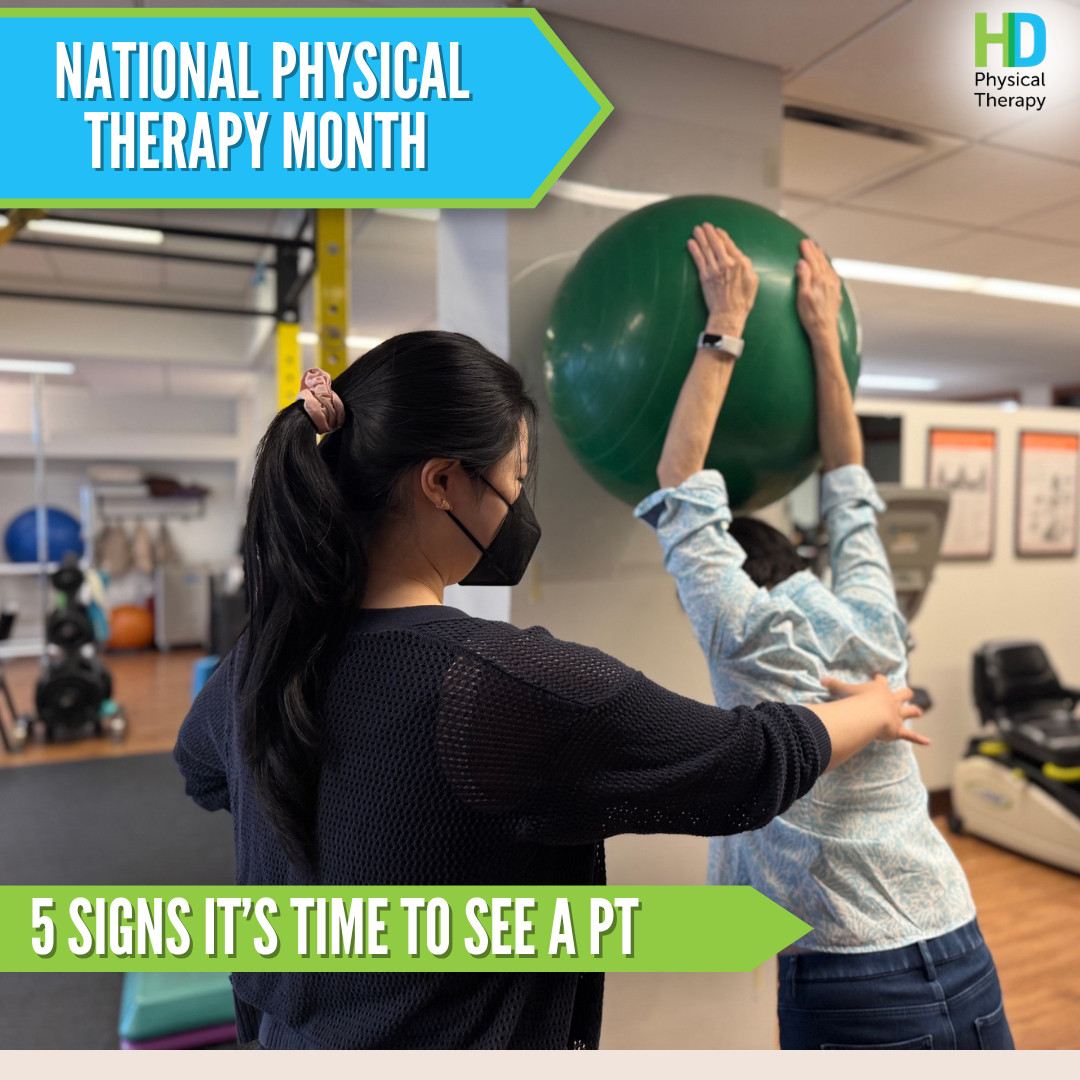
October is National Physical Therapy Month, and it is a good time to ask a question most people put off: is this something I should actually get looked at?
For a lot of people, the answer gets decided by default. The knee that aches on the stairs, the shoulder that complains when you reach for the top shelf, and the back that stiffens after a long day at the desk all get filed under “I’ll see how it feels next week.” Then next week turns into next month.
Part of the hesitation is not knowing where the line is. Most people assume physical therapy is something you get sent to after surgery or a major injury. In reality, many patients come to us long before anything is torn, broken, or scheduled for an operating room, and those are often the patients who recover the fastest.
The other part is that pain is easy to adapt to. You start taking the elevator, carrying your bag on the other shoulder, or skipping the run you used to look forward to. Each change feels small, but together they can turn a minor problem into a stubborn one.
At H&D Physical Therapy, we see patients at every stage, from weekend athletes and desk workers to people recovering from surgery or managing a long-standing condition. If you have been wondering whether it is time to see a physical therapist, these are the five signs we look for most often.
1. Your Pain Has Lasted More Than a Few Weeks
Minor strains and soreness usually improve on their own within a week or two. When pain hangs around longer than that, or fades and keeps coming back, something mechanical is often driving it. That could be a stiff joint, a weak muscle group, or a movement habit that keeps irritating the same tissue.
Common examples include:
- Low back pain that flares every time you sit for a long stretch
- Knee pain that returns each time you increase your running mileage
- Neck and shoulder tension that builds over the workweek
- An ankle that never felt quite right after a sprain
Rest can quiet these symptoms for a while, but it rarely fixes the cause. A physical therapist can identify what is keeping the problem going and give you a plan to address it directly.
When to seek care: If pain has lasted longer than two to three weeks, or if the same pain keeps returning, schedule an evaluation.
2. Pain or Stiffness Is Changing How You Move
Your body is very good at working around a problem. That is helpful in the short term, but compensations tend to create new problems over time. A limp that protects a sore knee can overload the hip on the other side. A stiff shoulder can cause you to hike your neck every time you reach.
Watch for changes like these:
- Favoring one leg when you walk or climb stairs
- Turning your whole body instead of your head to check your blind spot
- Using your arms to push yourself up from a chair
- Reaching or lifting with an awkward, guarded motion
These changes often happen without you noticing. Family members or coworkers sometimes spot them first.
When to seek care: If you have changed the way you walk, reach, bend, or lift to avoid pain, have a physical therapist assess what is happening before the compensation becomes its own problem.
3. You’ve Started Avoiding Things You Enjoy
One of the clearest signs that a problem needs attention is not the pain itself but what it has quietly taken away. Many patients do not come in because the pain is severe. They come in because they realize they have stopped doing something they love.
That might look like:
- Skipping your regular run, tennis match, or yoga class
- Avoiding the subway stairs or taking the long way to dodge a hill
- Turning down plans that involve a lot of walking
- Struggling to carry groceries, lift your kids, or garden the way you used to
Avoidance can feel like a sensible way to protect an injury, but over time it leads to lost strength, mobility, and confidence. Physical therapy focuses on getting you back to those activities safely, not on keeping you away from them.
When to seek care: If pain or stiffness has caused you to give up an activity for more than a few weeks, it is time to find out why.
4. You’re Noticing Numbness, Tingling, or Weakness
Numbness, tingling, and weakness can point to an irritated nerve, either where it exits the spine or somewhere along its path through the arm or leg. These symptoms deserve attention even when pain is mild or absent.
Common patterns include:
- Tingling or numbness in the fingers, especially at night or while typing
- Pain that travels from the neck into the arm, or from the low back into the leg
- A weaker grip, or dropping things more often than usual
- A foot that catches or slaps when you walk
Many of these conditions respond well to physical therapy. For symptoms in the hand, wrist, or elbow, our Certified Hand Therapists at our Midtown and South Slope locations specialize in exactly this kind of care.
When to seek care: Schedule an evaluation for numbness, tingling, or weakness that lasts more than a few days or keeps returning. Seek emergency care right away for sudden weakness, numbness on one side of the body, loss of bladder or bowel control, or numbness in the groin or inner thighs.
5. Your Balance Feels Off or You’ve Had a Fall
Balance depends on your inner ear, your vision, the sensation in your feet, and the strength in your legs and core all working together. When any part of that system weakens, the first sign is often a near miss: a stumble on an uneven sidewalk, a moment of unsteadiness on the stairs, or a hand that reaches for the wall more often than it used to.
Pay attention if you notice:
- Feeling unsteady when you turn quickly or look up
- Needing the railing on stairs you used to take easily
- Dizziness or spinning with certain head movements
- A recent fall, even one that did not cause an injury
A fall without an injury is still important information. It is often the first warning that strength, balance, or the vestibular system needs attention. Our vestibular therapists can evaluate the cause and build a program to help you feel steady again.
When to seek care: If you have fallen, nearly fallen, or started moving cautiously because you do not trust your balance, schedule an evaluation.
Bonus: You Have Surgery on the Calendar
Physical therapy is not only for after surgery. Prehabilitation, or “prehab,” is physical therapy before a planned procedure such as a joint replacement or ligament repair. Building strength and mobility beforehand can make the recovery that follows more manageable. If you have a surgery date set, ask your surgeon whether starting physical therapy now makes sense for you.
Why Waiting Makes Things Worse
It is natural to hope a problem will resolve on its own, and sometimes it does. When it does not, waiting tends to add new layers to the original issue. Muscles that are not being used lose strength. Joints that are not moving through their full range get stiffer. Compensations shift the load onto areas that were never part of the problem.
There is also a mental side. The longer you avoid a movement, the more uncertain it can feel to try it again. Earlier care usually means a shorter path back to normal.
What to Expect at Your First Visit
Your first appointment starts with a conversation about your symptoms, your history, and what you want to get back to. From there, your physical therapist will assess your movement, strength, and flexibility. Depending on the problem, they may also look at your balance, your posture, or the way you work at a desk.
By the end of the visit, you will have a clear explanation of what is likely driving your symptoms, a treatment plan built around your goals, and exercises to start at home. Your plan is then adjusted as you progress.
You Don’t Need a Referral in New York
Under New York’s direct access law, you can see a licensed physical therapist without a prescription from a physician. Direct access covers up to 10 visits or 30 days from your first evaluation, whichever comes first. After that, a referral is needed to continue treatment. Insurance coverage for direct access varies by plan, so it is worth checking with your insurer before your first visit.
The Takeaway
You do not need an injury, a surgery, or a doctor’s note to see a physical therapist. Persistent pain, changes in how you move, avoided activities, nerve symptoms, and balance problems are all signs that an evaluation could help. This National Physical Therapy Month, give that nagging issue the attention it deserves.
Schedule Your Evaluation Today
If any of these signs sound familiar, our physical therapists are ready to help you move with less pain and more confidence. Schedule an appointment at any H&D location.


You must be logged in to post a comment.