
If you have been to physical therapy elsewhere, the routine may sound familiar. You check in, get set up on a table or a machine, and your therapist moves between you and several other patients. Part of the hour is spent with an aide, part is spent waiting, and part is spent on exercises you could have done at home.
H&D Physical Therapy was founded to do the opposite. When insurance reimbursement cuts in the 1990s pushed many practices to see more patients per hour, our founders made a different choice: every patient would receive one-on-one physical therapy with a licensed therapist for the entire session. Nearly three decades later, that commitment has not changed.
It is not the easiest way to run a practice, but it is the way we believe physical therapy should work. Pain rarely has a single, simple source. Finding it takes time, attention, and a therapist who is focused on you from start to finish.
We treat people, not body parts. So what does one-on-one care actually change? Here are the five differences our patients notice most.
1. Your Therapist Is With You for the Entire Session
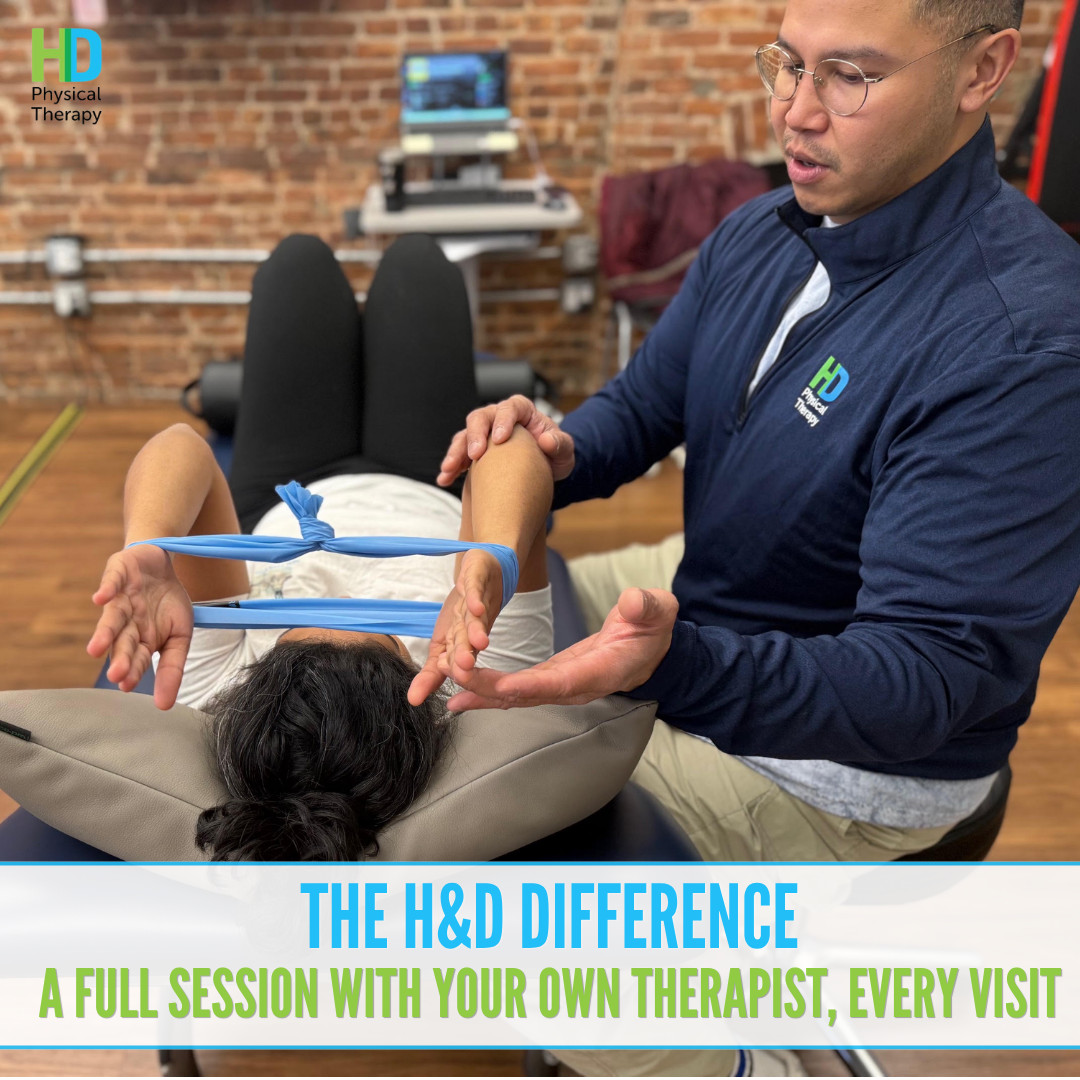
After your initial evaluation, every treatment session at H&D runs a full 45 to 60 minutes and is conducted entirely by your physical or occupational therapist. There is no handoff to an aide halfway through, and you are not sharing your therapist with the patient on the next table.
That means:
- Every exercise is supervised by a licensed clinician
- Your form is corrected in the moment, not at the next visit
- Your questions are answered as they come up
- Hands-on treatment is built into the session, not squeezed into the last few minutes
What it means for you: Every minute you spend in the clinic is spent with someone trained to move your recovery forward.
2. There Is Time to Find the Root Cause
Where it hurts is not always where the problem starts. The body works as a connected system, and pain in one area can be driven by stiffness, weakness, or a movement pattern somewhere else. Wrist pain and tingling in the fingers, for example, can come from the wrist itself or from nerve irritation and posture problems at the neck.
During your first visit, we ask more than “Where does it hurt?” We also want to know:
- When it hurts and what position you are in
- How it affects your work, sleep, and daily routine
- Where else you feel weak or stiff
- Whether you have had these symptoms before
One of our favorite examples involves a right-handed pitcher with recurring elbow pain. The fix turned out to be his left foot. Improving the mobility and balance of his landing leg corrected the inefficient movement pattern that was overloading his elbow, and the pain went away.
What it means for you: Treatment targets the source of the problem, not just the spot that hurts.
3. Your Treatment Adjusts in Real Time
Recovery does not move in a straight line. Some days a movement feels easier than expected; other days a flare-up changes the plan. When your therapist is with you for the whole session, those changes can happen on the spot.
Your therapist can:
- Add load or difficulty when you are ready for it
- Scale back when something is irritated
- Swap out an exercise that is not working for one that does
- Recheck your progress against your goals at every visit
What it means for you: Your plan keeps pace with your body instead of following a fixed template.
4. You Learn How Your Body Works
One-on-one time leaves room for something many patients tell us they never received elsewhere: real explanations. We want you to understand what is causing your symptoms, why each part of your plan matters, and what you can do between visits.
That includes:
- A clear explanation of your diagnosis in plain language
- Home exercises you know how to do correctly
- Guidance on the posture, workstation, sleep, or training habits that affect your recovery
- Open discussion about your plan of care at every stage
What it means for you: You leave each session more confident and better equipped to care for your body long after therapy ends.
5. You Work With Your Own Therapist
Working with your own therapist builds the kind of relationship a rotating schedule cannot. Your therapist knows your history, remembers what flared up last week, and understands what you are working toward.
That continuity shows up in practical ways:
- Less time repeating your story at each visit
- Earlier recognition of small changes, good or bad
- Goals that are set together and revisited together
- A therapist who is invested in your outcome
What it means for you: Your care feels like a partnership, not a series of appointments.
Bonus: Specialists Across the Practice
Our licensed therapists hold advanced certifications in a wide variety of specialties and manual therapy techniques. That depth means your one-on-one session can be led by a therapist trained for your specific condition. This includes orthopedic and sports injuries, post-surgical rehabilitation, pelvic health, vestibular therapy, and neurological conditions, as well as hand therapy with our Certified Hand Therapists at our Midtown and South Slope locations.
Why Many Clinics Work Differently
In a high-volume model, one therapist may oversee several patients in the same hour while aides or assistants handle much of the exercise portion. Some patients do well in that setting. When time is divided, though, the evaluation tends to stay narrow, and there is less room to catch the subtle movement problems that keep pain coming back.
What to Expect at H&D
Your first visit is a complete evaluation. Your therapist will review your history, observe how your joints move individually and together, assess your strength and endurance, and check for areas of tightness or tenderness. From there, you and your therapist will set goals together and build a treatment plan around them. Every visit after that is a full one-on-one session with your therapist.
Care Across New York City
Our one-on-one model is the same at all five of our clinics: Midtown, the Upper East Side, the Upper West Side, Park Slope, and South Slope. We also offer home visits, telehealth sessions, and onsite corporate clinics, and H&D has been chosen as the sole provider of therapy services for 10 Fortune 500 companies.
The Takeaway
One-on-one care is not a perk at H&D. It is the foundation of how we practice. A full session with your own therapist means more time to find the real cause of your pain, a plan that adapts as you improve, and a clear understanding of your own body. That is the H&D difference.
Schedule Your Evaluation Today
Experience what one-on-one care can do for your recovery. Schedule an appointment at any H&D location.



You must be logged in to post a comment.